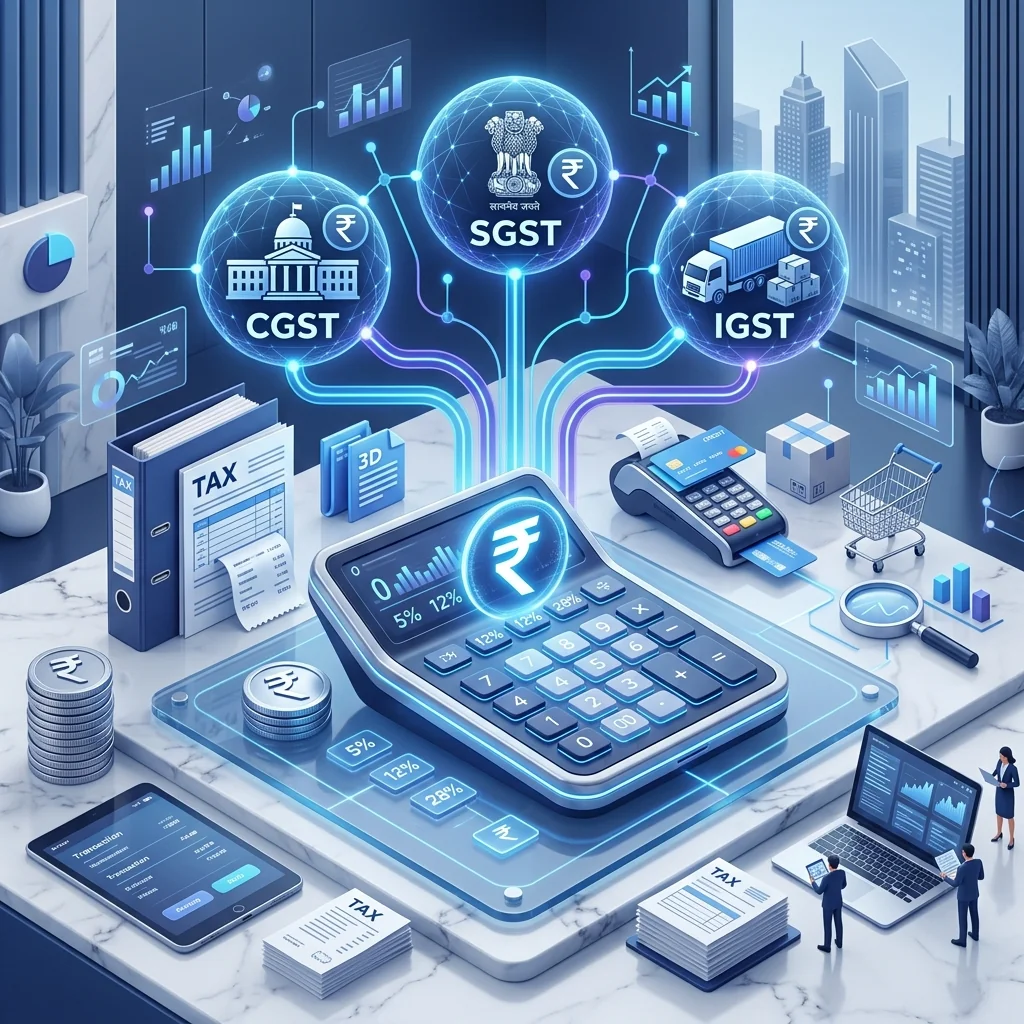
CGST, SGST & IGST Calculator: Understanding the Difference and How to Calculate GST Correctly
The Goods and Services Tax (GST) in India is a comprehensive, multi-stage, destination-based tax that has replaced multiple indirect taxes. Understanding the difference between CGST, SGST, and IGST is fundamental for every business owner, accountant, and e-commerce seller. This guide explains each component in detail, shows how they are calculated, and helps you determine which tax applies to your transactions.
What is CGST (Central Goods and Services Tax)?
CGST is the tax levied by the Central Government of India on intra-state supply of goods and services. When a transaction occurs within the same state—for example, a seller in Maharashtra sells goods to a buyer in Maharashtra—CGST is applied along with SGST. The CGST rate is always exactly half of the total applicable GST rate. For example, if the GST rate is 18%, the CGST component would be 9%.
CGST revenue goes directly to the Central Government's consolidated fund. The tax is governed by the CGST Act, 2017, which provides rules for registration, invoicing, returns filing, refunds, and enforcement related to the central tax component.
What is SGST (State Goods and Services Tax)?
SGST is the tax levied by the State Government on intra-state supply of goods and services. It is always applied alongside CGST for transactions within the same state. Like CGST, the SGST rate is exactly half of the total GST rate. If the total GST rate is 18%, SGST would be 9%.
SGST revenue goes to the respective State Government. Each state has enacted its own SGST Act, though the provisions are largely uniform across all states. For Union Territories without a legislature, the equivalent tax is called UTGST (Union Territory GST), which functions identically to SGST.
What is IGST (Integrated Goods and Services Tax)?
IGST is the tax levied by the Central Government on inter-state supply of goods and services. When a transaction crosses state boundaries—for example, a seller in Gujarat ships goods to a buyer in Karnataka—IGST is applied instead of CGST+SGST. The IGST rate equals the full GST rate (e.g., 18% IGST if the GST rate is 18%).
IGST is also applicable on imports into India and certain specified supplies. The IGST revenue is shared between the Central and State Governments based on a formula determined by the GST Council. This mechanism ensures that the destination state receives its fair share of tax revenue.
How to Determine Which Tax Applies
The "Place of Supply" rules under Sections 10-14 of the IGST Act determine which tax component applies:
- Same State (Intra-State): If the supplier's location and the place of supply are in the same state, apply CGST + SGST (each at half the GST rate).
- Different States (Inter-State): If the supplier's location and the place of supply are in different states, apply IGST (at the full GST rate).
- Imports: All imports are treated as inter-state supplies, so apply IGST.
- Exports: Exports can be zero-rated (no tax) or taxed with IGST (refundable).