Mastering Amazon Visibility: 5 Advanced SEO and Ads Tips for 2026
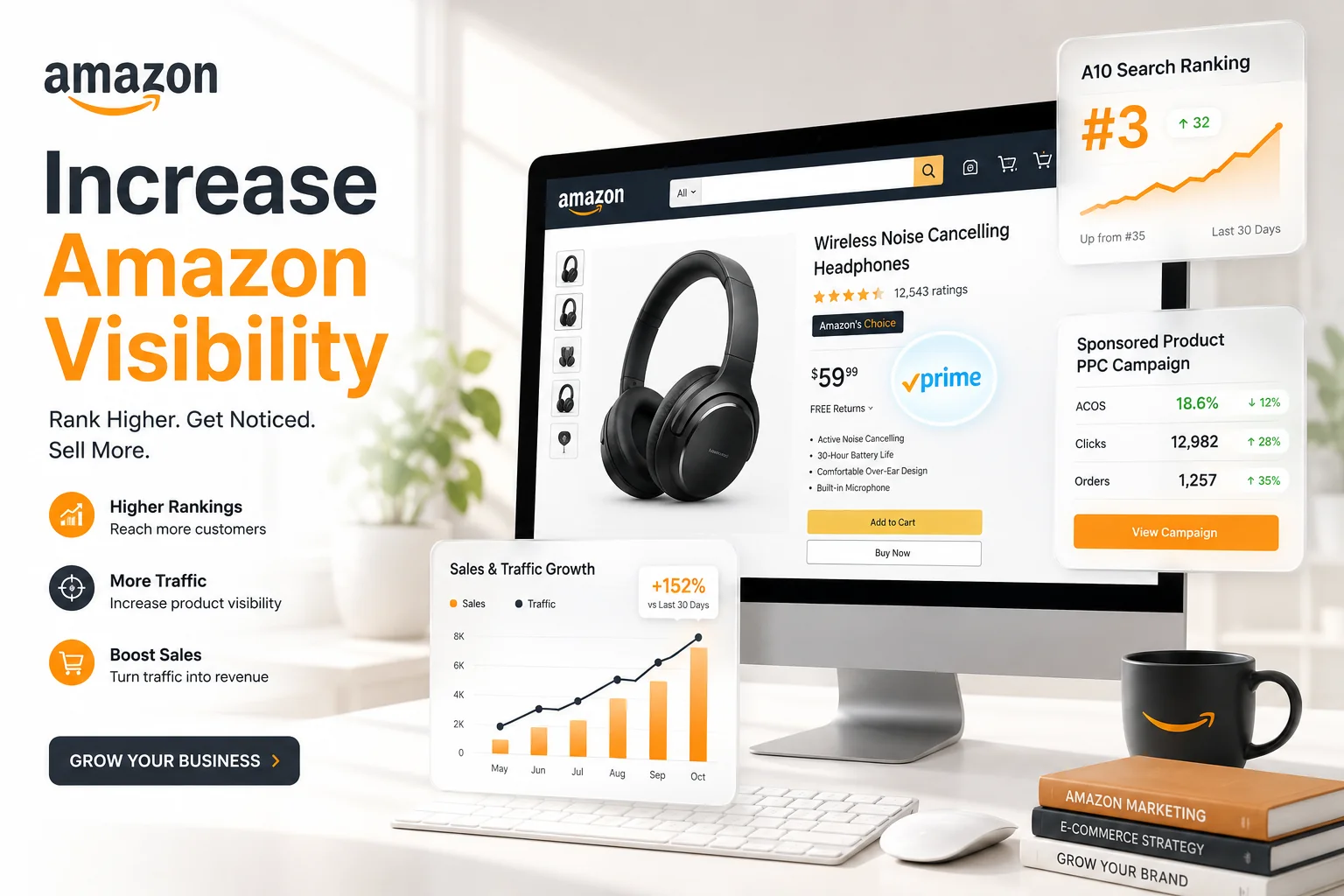
Amazon is the largest marketplace in the world, and with millions of products listed, "getting seen" is the biggest challenge for any seller. In 2026, the Amazon algorithm (often referred to as A10) has become more intelligent, focusing heavily on customer trust, brand authority, and off-site traffic.
If your products are buried in the search results, your sales will suffer. This guide explores 5 advanced strategies to skyrocket your Amazon visibility and dominate your category.
1. Optimize for the "A10" Search Algorithm
While the old algorithm was all about internal clicks and sales, the modern Amazon algorithm prioritizes relevancy and customer satisfaction. To rank higher, you must focus on:
- Conversion Rate: It's not just about how many people see your page, but how many *buy*. If you have high traffic but low sales, Amazon will drop your ranking.
- Off-site Traffic: Sending customers to Amazon from Facebook, Instagram, or TikTok is now a huge ranking signal. It tells Amazon that your product is popular outside of their ecosystem.
2. Use A+ Content (Enhanced Brand Content)
If you have a registered brand, you must use A+ Content. Instead of a boring text description, you can add high-quality images, comparison charts, and detailed storytelling. This doesn't directly affect SEO, but it increases conversion rates, which in turn boosts your organic search ranking.
3. Leverage the Power of Amazon FBA
Sellers using FBA (Fulfillment by Amazon) get the Prime badge. This is the single biggest visibility booster on the platform. Prime members (who spend 2x more than non-Prime members) often filter search results to see *only* Prime-eligible products. If you are not using FBA, you are invisible to millions of high-value shoppers.
4. Smart PPC (Pay-Per-Click) Advertising
Advertising is no longer optional on Amazon. To win visibility, you need to use a mix of Sponsored Products, Sponsored Brands, and Sponsored Display ads.
- Auto vs Manual: Use Auto campaigns for keyword discovery, then move the winning keywords to Manual campaigns for better ROI.
- Video Ads: Sponsored Brand Video ads appear in the middle of search results and have a much higher engagement rate than traditional image ads.
5. Win and Protect the "Buy Box"
The "Buy Box" is the white box on the right side of the product detail page where customers click "Add to Cart." If you lose the Buy Box (due to price wars or poor account health), your visibility disappears instantly. Monitor your "Account Health" metrics closely—keep your ODR (Order Defect Rate) below 1% to ensure you remain the featured seller.
Deep Dive: Core Principles & Operational Architecture
Mastering Mastering Amazon Visibility requires a rigorous understanding of both platform algorithms and practical ground operations. For high-volume sellers in India, small efficiencies compound across thousands of monthly orders, separating profitable multi-channel enterprises from struggling accounts.
Whether you operate primarily on Flipkart, Amazon, Meesho, or through direct-to-consumer (D2C) channels, establishing structured, repeatable standard operating procedures (SOPs) ensures consistency, minimizes human error during peak packing hours, and protects your account health score from automated policy violations.
Comprehensive Step-by-Step Strategic Framework
To implement industry best practices for Mastering Amazon Visibility, follow this proven five-phase execution roadmap:
- Audit & Baseline Assessment: Begin by collecting historical operational data from the past 90 days. Identify recurring bottlenecks, margin leaks, return patterns, and compliance gaps.
- Infrastructure & Process Setup: Implement dedicated software workflows, automated client-side calculation tools, and standardized labeling systems. Eliminate manual calculations and spreadsheet dependencies where possible.
- Quality Control & Verification Protocols: Establish multi-point verification checks before any order is dispatched, any invoice is generated, or any campaign budget is allocated.
- Continuous Performance Benchmarking: Track core key performance indicators (KPIs) on a weekly basis. Compare your metrics against top-tier seller benchmarks in your specific product category.
- Optimization & Iterative Scaling: Reinvest recovered capital and operational time into catalog expansion, private-label branding, and optimized inventory depth across regional fulfillment centers.
Real-World Business Case Study & Numerical Analysis
Consider a mid-sized online merchant processing 1,500 monthly shipments in the competitive fashion and home accessories category. Prior to streamlining their operational workflow for Mastering Amazon Visibility, the seller experienced an average overhead loss of ₹18 to ₹35 per order due to operational friction, processing delays, and unverified deductions.
| Metric Area | Before Optimization | After Implementation | Net Operational Impact |
|---|---|---|---|
| Processing Time Per Unit | 4.5 minutes | 1.2 minutes | 73% time saved per dispatch batch |
| Error & Discrepancy Rate | 6.8% of dispatches | 0.4% of dispatches | Elimination of penalties & RTO flags |
| Monthly Overhead Savings | ₹0 (Baseline) | ₹32,500 / month | Direct bottom-line profit injection |
Common Pitfalls to Avoid
- Ignoring Automated Algorithm Updates: E-commerce marketplaces update their ranking and compliance algorithms frequently. Relying on outdated strategies risks sudden traffic loss.
- Neglecting Regular Data Reconciliation: Failing to match platform reports against actual bank settlements and tax portal filings leads to uncollected reimbursements and surprise tax penalties.
- Relying on Manual Calculations: Manual data entry introduces mathematical errors in tax breakdowns, HSN allocation, and margin evaluations. Always use automated, tested calculation engines.
- Compromising on Document Integrity: Low-resolution shipping labels, illegible barcodes, or non-compliant invoices cause courier scan failures and buyer disputes.
Frequently Asked Questions (FAQs)
How does Mastering Amazon Visibility directly impact seller profitability?
By eliminating operational inefficiencies, reducing return rates, ensuring full tax credit recovery, and enhancing catalog search rankings, proper implementation directly widens gross profit margins by 3% to 8%.
Is this process applicable for small sellers with low daily order volume?
Yes. In fact, implementing these best practices early prevents compounding administrative debt as your order volume scales from 10 orders a day to several hundred.
What tools are recommended to automate this workflow?
Utilize Private Crop's suite of free client-side utilities—including automated shipping label croppers, PDF mergers, and GST invoice calculators—to handle repetitive processing securely inside your browser without monthly software subscription costs.
Daily Operational Checklist for E-Commerce Sellers
- ☐ Verify all pending order dispatches within platform SLA windows.
- ☐ Inspect cropped shipping labels for high-contrast barcode clarity before printing.
- ☐ Log and reconcile incoming customer returns and courier RTO packages.
- ☐ Cross-check tax rates, HSN codes, and invoice serial numbers against current regulations.
- ☐ Archive digital copies of all daily settlement files and tax invoices for long-term audit readiness.
Conclusion
Winning on Amazon requires a holistic approach—from technical SEO and smart advertising to operational excellence. By focusing on conversion rates and brand authority, you can climb the search results and stay ahead of the competition. For more insights on growing your e-commerce business, visit our seller blog.
Frequently Asked Questions
The Amazon A10 algorithm is the search ranking engine that determines product placement. Unlike A9, A10 puts heavier weight on organic sales velocity, customer reviews, seller account health, off-site traffic, and click-through-rate (CTR) rather than just PPC advertising sales.
FBA (Fulfillment by Amazon) automatically qualifies your products for Amazon Prime. This boosts conversion rates because Prime members trust fast, free shipping. This increased conversion rate directly signals the Amazon algorithm to rank your listings higher.
A good conversion rate on Amazon typically ranges from 10% to 15%. For highly optimized listings with premium A+ content and competitive pricing, it can reach 20% or higher.
🚀 Grow Your Seller Account with Our Tools
Process labels 10x faster, calculate absolute profit metrics and improve product listings instantly!



Frequently Asked Questions
What is the Amazon A10 search algorithm?
The Amazon A10 algorithm is the search ranking engine that determines product placement. Unlike A9, A10 puts heavier weight on organic sales velocity, customer reviews, seller account health, off-site traffic, and click-through-rate (CTR) rather than just PPC advertising sales.
How does FBA affect my search ranking on Amazon?
FBA (Fulfillment by Amazon) automatically qualifies your products for Amazon Prime. This boosts conversion rates because Prime members trust fast, free shipping. This increased conversion rate directly signals the Amazon algorithm to rank your listings higher.
What is a good conversion rate for Amazon listings?
A good conversion rate on Amazon typically ranges from 10% to 15%. For highly optimized listings with premium A+ content and competitive pricing, it can reach 20% or higher.